Page 1 of 1
Billet 4AGE Block...
Posted: Fri May 02, 2014 3:23 pm
by jondee86
When stock just doesn't do it for you... and you need something
with more strength and less weight... how about a billet block ??


Supercharged 20V racecar with CNC'd aluminum block built here in NZ

Engine makes around 365hp at 8000rpm on methanol without running
an intercooler. Opcon Autorotor OA3150 twin screw supercharger.
Cheers... jondee86
Re: Billet 4AGE Block...
Posted: Fri May 02, 2014 4:14 pm
by oldeskewltoy
I wonder why they designed the block with such a steep angle...????
Re: Billet 4AGE Block...
Posted: Fri May 02, 2014 4:19 pm
by yoshimitsuspeed
oldeskewltoy wrote:I wonder why they designed the block with such a steep angle...????
My first thought was that the must be running two of them like the v8 Hyabusa lol.
Re: Billet 4AGE Block...
Posted: Fri May 02, 2014 7:44 pm
by jondee86
It's in a speedway car and they only turn left when racing, so
I guess keeping the C of G down and making more space available
for mounting the charger came into it. The block is described as
being "two-part" but I haven't seen a picture of the bottom end.
Again, I would guess that the main caps may be integrated with
the dry sump pan.
Cheers... jondee86
Re: Billet 4AGE Block...
Posted: Fri May 02, 2014 10:43 pm
by yoshimitsuspeed
Seems like a lot of work and money considering how much power people have made 'reliably' on the stock block. If they were going for 900 HP or something it would seem a lot more impressive to me.
Re: Billet 4AGE Block...
Posted: Sat May 03, 2014 1:53 am
by jondee86
I'm pretty sure that if a stock block could reliably last for three or
four six lap sprints, and then a 30 lap final on the same Saturday
night, they would still be using them.
Cheers... jondee86
Re: Billet 4AGE Block...
Posted: Sat May 03, 2014 11:15 am
by oldeskewltoy
jondee86 wrote:It's in a speedway car and they only turn left
and there is your answer... high.. constant G load and the oil drains are all on the left, that steep an angle is likely needed to not load up the head.....
Re: Billet 4AGE Block...
Posted: Fri May 09, 2014 12:57 am
by jinx
good grief, what a lotta effort..... must really loovvveeee the "4age" basic architecture
is it still a 1.6 ?
I suspect with this capability, they do other motors as well ?
Re: Billet 4AGE Block...
Posted: Fri May 09, 2014 2:32 am
by jondee86
yoshimitsuspeed wrote:oldeskewltoy wrote:I wonder why they designed the block with such a steep angle...????
My first thought was that the must be running two of them like the v8 Hyabusa lol.
Just for you...

What is most interesting is that the car is powered by a New Zealand
designed and built engine. The design work of Mechanical Engineer Simon Longdill,
the engine uses Kawasaki ZX12R 1200 cylinder heads and cylinder blocks to form
an 80 degree V8 displacing 2400cc (147C.I.)
Cheers... jondee86
Re: Billet 4AGE Block...
Posted: Fri May 09, 2014 2:37 am
by jondee86
jinx wrote:good grief, what a lotta effort..... must really loovvveeee the "4age" basic architecture
is it still a 1.6 ?
I suspect with this capability, they do other motors as well ?
Still a 1600cc engine as far as I know. I think the guy just got
tired of throwing broken GZE blocks in the bin, and having access
to a CNC machining centre, decided to make his own.
The bearing caps are integrated with the dry sump pan, and the
two parts of the block are held together with 20 studs.
Cheers... jondee86
Re: Billet 4AGE Block...
Posted: Fri May 09, 2014 11:39 am
by oldeskewltoy
spoke to Loynings... the rules preclude them from using anything but a "stock" block and head.... They are allowed to remove material.... but are NOT allowed to add it (weld in new material)
Re: Billet 4AGE Block...
Posted: Fri May 09, 2014 2:56 pm
by jondee86
Yes, and there are also limits to how much laydown (lean) you can
use when mounting the engine, and the offset of the centerline of
the crankshaft from the centerline of the chassis. Because the cars
only turn one way, you can get some advantage from moving the
C of G towards the inside of the track.
Cheers... jondee86
Re: Billet 4AGE Block...
Posted: Fri May 09, 2014 9:51 pm
by yoshimitsuspeed
oldeskewltoy wrote:spoke to Loynings... the rules preclude them from using anything but a "stock" block
But the real question is would they run a custom block if they could?
Re: Billet 4AGE Block...
Posted: Sat May 10, 2014 8:09 am
by oldeskewltoy
yoshimitsuspeed wrote:oldeskewltoy wrote:spoke to Loynings... the rules preclude them from using anything but a "stock" block
But the real question is would they run a custom block if they could?
I'm sure they would... just for its capability to be customized for each application.
... but if you are asking if they
need the extra strengh... a properly braced 7-rib holds up fine.
Re: Billet 4AGE Block...
Posted: Thu May 29, 2014 4:17 am
by Anthony Batley
Hi guys.
Our rules in NZ do permit the use of a billet block but for the international POWRI series this engine isn't permitted. The bore centreline is laid over at 45deg to give a lower COG and to improve packaging - it certainly helped when positioning the supercharger which weighs a healthy 13kg. All up the car (without fuel) weighs 410kg so the supercharger adds a decent percentage. Ideally I would still be running the iron block but they simply aren't strong enough for the punishment this engine gets - I have split bores on three 7 rib blocks due to fatigue and decided to pursue the stronger aluminium block with wet sleeves. The new block is two piece and the mains and dry sump pick-ups is all one piece - really stiff and makes it very quick to assemble and disassemble and again a low COG with no bulky sump.
Cheers, Anthony
Re: Billet 4AGE Block...
Posted: Thu May 29, 2014 12:28 pm
by oldeskewltoy
Anthony Batley wrote:Hi guys.
Ideally I would still be running the iron block but they simply aren't strong enough for the punishment this engine gets - I have split bores on three 7 rib blocks due to fatigue
Welcome!!!
please do tell... under what circumstances did the blocks split? "split bores"????
Re: Billet 4AGE Block...
Posted: Thu May 29, 2014 5:39 pm
by Anthony Batley
Hi,
The bore split each time - I have a feeling that it was due to the larger 82mm bore with too little wall thickness. The small engine takes a hammering and in a race situation sits between 5000 - 9000 rpm for decent periods and I believe the bores have been swelling and the cast iron fatiguing. Interestingly the split was on the right side (non thrust side) I actually set an iron block up in the milling machine and machined away the bores with the hope of fitting wet sleeves but there simply wasn't enough material left. In doing so I noticed the the bore wall thickness was incredibly thin in places. The new wet sleeves are just under 6mm thick and Darton (the manufacturer of the sleeves) say they will be fine with 40+ psi boost. If I ever have an issue with a bore I can pull the sleeve and replace it but hopefully this won't be the case.
Cheers
Anthony
Re: Billet 4AGE Block...
Posted: Fri Jul 11, 2014 12:14 am
by paseobeater
nice piece of engineering!!!

Re: Billet 4AGE Block...
Posted: Thu Aug 07, 2014 9:31 pm
by Esenpai
well thats purdy.
Re: Billet 4AGE Block...
Posted: Fri Aug 08, 2014 3:41 am
by Rogue-AE95
jondee86 wrote:
The head studs are shaved down in the back row there, below the threads. Is this basically what should be done with ARP head studs for a 4A-GE?
Re: Billet 4AGE Block...
Posted: Fri Aug 08, 2014 2:40 pm
by jondee86
Stress Riser EliminationFatigue failure is frequently caused by localized stress risers, such as sharp corners.
In bolts, this would correspond to the notch effect associated with the thread form. It
is well known that the maximum stress in an engaged bolt occurs in the last engaged
thread. By removing the remaining, non-engaged threads, the local notch effect can be
reduced. This leads to the standard configuration used in most ARP rod bolts: a reduced
diameter shank and full engagement for the remaining threads. Providing a local fillet
radius at the location of the maximum stress further reduces the local notch effect.
Thus this configuration represents the optimum with respect to fatigue strength.
The reduced diameter shank is helpful in another sense. It reduces the bending stiffness
of the bolt. Therefore, when the bolt bends due to deformation of the connecting rod,
the bending stresses are reduced below what they would otherwise be. This further
increases the fatigue resistance of the bolt. A typical bolt configuration is shown below.
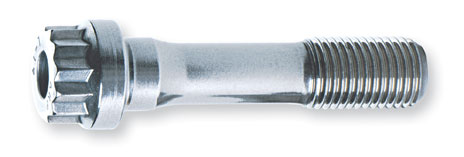
Cheers... jondee86
Re: Billet 4AGE Block...
Posted: Fri Aug 08, 2014 5:19 pm
by Rogue-AE95
Interesting.
Re: Billet 4AGE Block...
Posted: Wed Aug 27, 2014 8:25 am
by subiemonger
interesting, is that billet block sleeved? The picture of the short block make it look like it had huge sleeves
Re: Billet 4AGE Block...
Posted: Wed Aug 27, 2014 3:19 pm
by jondee86
Wet sleeves with a wall thickness of just under 6mm according to
the guy who builds the engine. So there must be a flange at the top
for locating and retaining the sleeve.
Cheers... jondee86
Re: Billet 4AGE Block...
Posted: Wed Oct 08, 2014 5:11 am
by Anthony Batley
The studs are stock ARP and run all the way down to the base of the sleeve - they are a replacement for a Subaru engine and I used these because they are the right length and available in ARP2000 material. They are relieved in between the threads to provide a length that can stretch without creating a stress concentration. Stretch is good as even if the head gasket relaxes a little overtime there is plenty of stretch in the stud and still plenty of clamping force.
Cheers
Anthony
Re: Billet 4AGE Block...
Posted: Sun Nov 16, 2014 7:18 am
by chi-town
If the bores were splitting why not just use a ductile iron sleeve in a stock block to be rule compliant for all series?
Re: Billet 4AGE Block...
Posted: Thu Nov 20, 2014 12:45 pm
by jondee86
Anthony Batley wrote:I actually set an iron block up in the milling machine and machined away the
bores with the hope of fitting wet sleeves but there simply wasn't enough material
left. In doing so I noticed the the bore wall thickness was incredibly thin in places.
The new wet sleeves are just under 6mm thick and Darton (the manufacturer of
the sleeves) say they will be fine with 40+ psi boost.
Cheers... jondee86