BroBri wrote:Thank you yoshimitsuspeed for the info.
When you talk about the Supertech oversized pistons, what exactly do you mean?
Are they longer on top, thereby creating a smaller cylinder volume when they are at bottom of stroke?
Technically yes but it's at the top of the stroke you are concerned with. The bore and the stroke sets the displacement so that doesn't change.
The piston fills more area in the combustion chamber so it compresses the air more creating a more powerful combustion. At a point that compression can be so high it can cause preignition or detonation.
BroBri wrote:I race on an asphalt circle track, and the rules for my class only allow .04" overbore from stock, and a max compression of 12:1
.04" is a little over 1mm so you could run their .5mm over or 1mm over. Starting with the .5mm over means you could bore the block one more time and step up to the 1mm over in the future. If you went with the 1mm over you would need to get a new block if you wore out the bores.
The supertechs should be a good option but if you are serious about being competitive I would probably go with a custom piston designed specifically for your application and max compression. I can get custom Wisecos made for about $100 more than the supertech pistons and they will give you a notable edge. I can also get customs from CP or JE if you prefer but the cost is slightly higher.
BroBri wrote:Can you tell me the max valve lift before I need to rework pistons to prevent interference?
On the stock pistons I cannot.
I could find out on the Supertech 18mm. The 20mm wristpin pistons will actually be non interference with the poncams so you could throw a ton of cam at them without worrying about hitting. I did this because I wanted a high performance alternative to the OEM pistons. Something that would be stronger, higher compression and better than stock in every way while staying non interference with my biggest selling cam. This piston is for daily drivers and mild builds that want good performance for a long time. They are not optimized for max performance.
The great thing about going with a custom piston is you can design it specifically around the cams you plan to use. You can minimize valve reliefs and dome making the flattest piston possible. This reduces sharp edged and complex contours that can lead to preignition, detonation or an uneven burn. If you think you may want to run a little more cam down the road then we can plan for that to give you a little room for changes.
It's also at this point that you want to decide if you want to run bigger valves or anything like that since you will need to plan it into the design.
In a situation like yours it really comes down to two things. What are you allowed to do and what can you afford to do.
BroBri wrote:I also see that a 264 degree duration is the limit for the stock ECU.
Limit is really a misnomer. The NA ECU has been boosted to over 150 WHP. If it can fuel for that much air on boost than it can fuel for that much air on cams.
The problem is that bigger cams move the power up in the rev range and at a point your peak power will be above the stock redline. The ECU can still run the motor fine but with the stock rev limit you won't be able to access the power above redline.
There is also the issue that lift is only one part of the equation. As OST pointed out at one point the poncams with 264 deg total duration have 222 deg duration at .05" whereas the Web 101 with 250 deg total duration cams have 229 deg lift at .050 so the poncams total duration is significantly higher but the web cams are just slightly higher in the range that is really important. If WEB made a 264 rated cam with a similar profile and proportionally increased lift it would act like a much bigger cam than the 264 poncam.
For a racing motor I think a litttle bigger than the poncam could be advantageous. Even if you can't take advantage of all the power on the stock ECU you should still be able to get at least the same powerband as the poncams under the max rev limit. If you decide to go to aftermarket engine management then you would have even more available to you.
I would really like to see what this cam can do.
http://www.camshaftshop.com/products.ph ... =818#specsI don't have it on my website but I can get a pretty decent price on it.
I think that cam with 12:1 compression would be pretty impressive across the rev range.
If I dropped a pair of your cams in, would I need to modify pistons?
You wouldn't need to but you would want to.
Bigger cams gain you more high end power but sacrifice low end. Low end is also where detonation is the most likely so a bigger cam means you can run more compression. If you balance this right you can have as much or more power in the low end while gaining a lot of power in the high end.
Here is a dyno that shows what I mean.
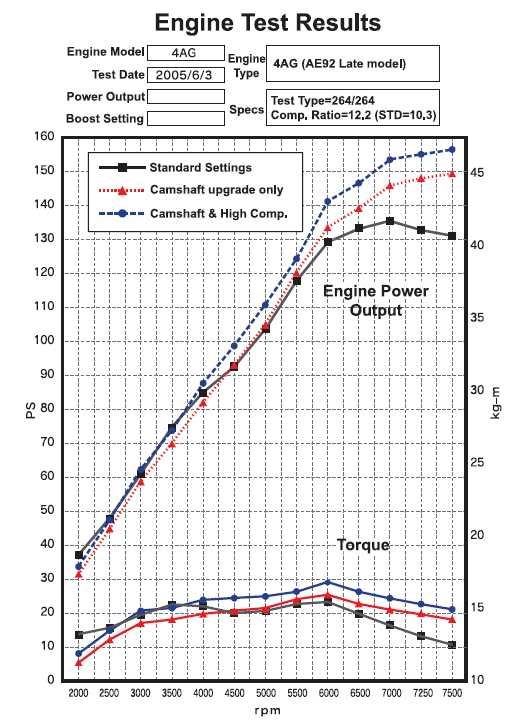
You can see that the poncam with stock pistons looses just a little power under 4000 RPM.
On the other hand the camshaft plus high comp pistons maintains the higher power up till 4k same as the smaller cams but after 4k the power is well above both other dynos.
If you want to maximize the performance of a motor you want to design the cams and pistons around each other.
The power loss under 4k isn't very big on the poncams but the bigger the cam you run the bigger that loss will be unless you make up for it with compression.
Would I see a big difference in power?
You can see the differences with the poncams on the dyno above.
Here is another example.
Here is a stock 4A AW11 dyno.

VS 11:1 compression and poncams.

His car wasn't very well tuned on this run and he is quite confident he has picked up a noticeable bit more power just with some tweaks with the stock electronics.
Add some well done Port n Polish work and there should be a bit more to be gained.
Personally I am a big fan of boost. Bang for the buck it's hard to beat. When it comes to real racing though you are limited by the rules of your class and in that case the rules are much different.